
The South Florida People’s Budget Lydia Ghuman Miami
When Budgets Help the Most Marginalized, They Create Better Results for Everyone
The South Florida People’s Budget focuses on building a codified participatory budgeting process in Miami, Florida (codified meaning this process will be created through policy). A codified participatory budgeting process allows Miami constituents to directly control a portion of Miami-Dade County’s budget and decide each year what local needs their taxpayer dollars should fund. This project addresses the community’s need to tackle the affordability crisis in Miami-Dade County, and the need for local funds to financially support innovative local services that enhance quality of life. Nearly 400,000 people in Miami-Dade County live below the federal poverty line, despite rising affordability costs in the county and the county’s budget being 12.9 billion dollars.
This project is focused on building a diverse coalition of South Florida organizations and individuals that centers low-income residents in the participatory budgeting process, which can be replicated in other South Florida counties.
This project is motivated by Lydia’s firsthand experience with the negative impacts of policing-for-profit policies and poorly managed city budgets. Lydia believes that when budgets help the most marginalized, they create better results for everyone.
Breaking Silos, Bringing Organizations Together
The project’s key achievements include: (1) building a coalition of 30 organizations dedicated to advancing participatory budgeting in Miami-Dade County and expanding the model across South Florida. The coalition brought together faith-based organizations, nonprofits, government officials, and community leaders, breaking down long-standing silos and fostering collaboration among groups that had previously never worked together or, in some cases, never even connected; (2) securing commitments from three Miami-Dade County Commissioners to sponsor the policy, leaving the campaign just one vote short of a majority needed for passage; and (3) canvassing more than 3,000 households to raise awareness about participatory budgeting and the campaign’s goals, resulting in over 100 new volunteer canvassers joining the effort and helping expand community outreach.
More Inclusive Civic Participation and Community-led Advocacy
The project partially achieved its original goals of building a coalition and centering the voices of low-income residents in decision-making processes. Through targeted canvassing efforts in low-income communities, the project identified and engaged local leaders who became active participants in the campaign. Community members were empowered to share their perspectives directly with decision-makers through public comments supporting the adoption of the participatory budgeting policy. The campaign also successfully launched a public event that helped build awareness, mobilize supporters, and strengthen momentum toward policy adoption. Together, these activities laid important groundwork for more inclusive civic participation and community-led advocacy.
While the project’s original goal was to pass the participatory budgeting policy by the end of the fellowship, Lydia still needs to secure one more vote from the Miami-Dade County Commission to pass the policy. The advocacy process simply took much longer than expected. This is because a strong coalition is needed to pass this policy, and with so many things going on in the Miami-Dade community right now (increased ICE raids, federal programs providing social services being gutted, and an increase in rents county-wide), it took a lot longer to approach and get coalition partners to sign on, as everyone is in crisis mode right now.
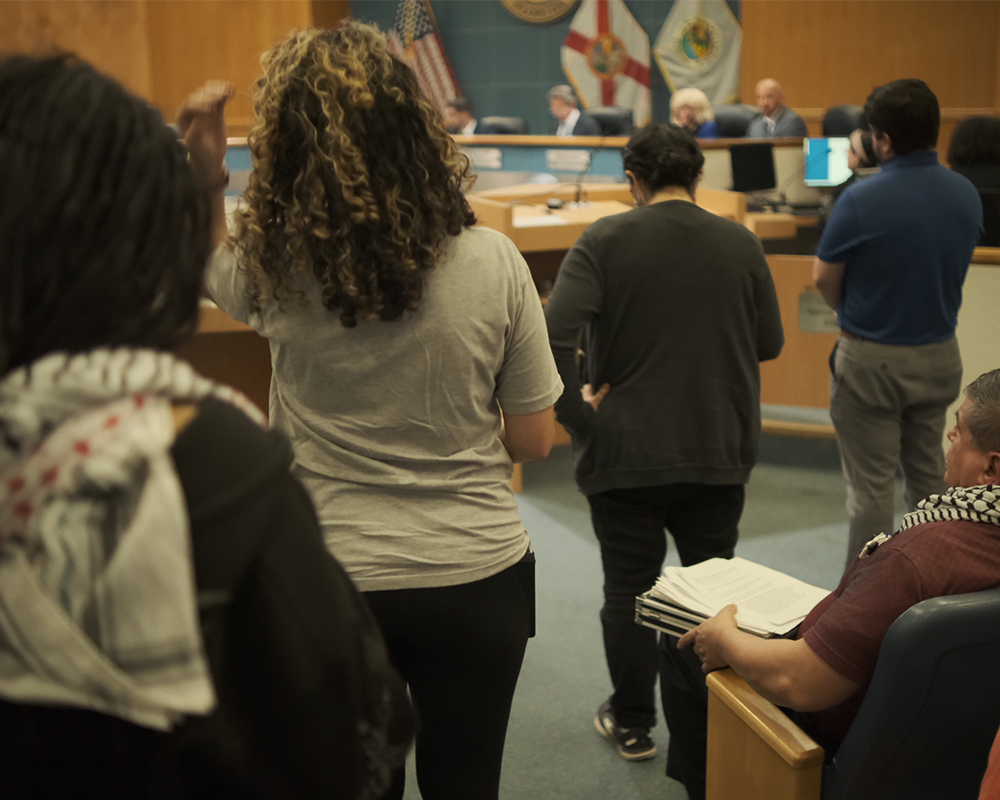
A picture of volunteers in a line to give public comment about why the participatory budgeting policy is needed.
A New Coalition in Miami-Dade County Focused on Budget Justice
This project had multiple benefits for the community. The project created a new coalition in Miami-Dade County focused on budget justice and brought together organizations across class, racial, and religious lines that had never worked together before. This project built a strong base of low-income Miami residents in neighborhoods often ignored and rallied them to pass a new policy. Usually, when residents are surveyed in this neighborhood, it is to join a protest, a tenant union meeting, or to go vote. These are all important, but campaigns and organizations rarely canvass and build a base to mobilize residents to pass a policy that will immediately change their lives. This has excited the community and mobilized community members who normally aren’t involved in the political process. We canvassed about 3,500 homes: 52% said this was their first time getting involved in a local campaign. All individuals who were canvassed are living below the federal poverty line, and 80% of them are people of color. Furthermore, Lydia hosted an event where she publicly launched the campaign, raising awareness among 500 people about the power this project has built and the participatory budgeting policy they are working to pass.
From Skeptic to Advocate: Lea’s Story
A story that illustrates the project’s impact is that of a volunteer known as Lea (a pseudonym). During a community canvassing effort, Lydia and other volunteers visited Lea’s home to share information about the campaign to advance a participatory budgeting policy. Through survey conversations, they learned that Lea was struggling to afford rent and groceries while caring for two children. Initially skeptical about the proposed policy, she agreed to attend a neighborhood meeting to learn more. After participating in the meeting, Lea became actively involved in the campaign, attending meetings with elected officials and advocating for the adoption of participatory budgeting. She shared how the policy could improve her family’s circumstances and explained that it was the first grassroots campaign she had ever joined because she believed so strongly in its potential. Lea’s testimony played an important role in securing the support of a Miami-Dade Commissioner. Since then, she has become one of the project’s most dedicated volunteers, regularly canvassing, sharing her story, and encouraging others to get involved.
Throughout the fellowship year, I learned how to be a better leader, how to be a better project manager, and how to scale quickly through training that enhanced volunteers’ skills, and in turn, allowed them to train and scale up new volunteers. On the other hand, I would have focused more on building the project structure and training (volunteer training, canvassing routes, etc.) before reaching out to onboard volunteers.
New Partnerships & Community Connections
Lydia built new relationships with CAIR-Florida, State Voices for Florida, Catalyst Miami, The Equality Fund, Rockefeller Brothers Foundation, Florida Rising, Faith for Florida, South Florida Muslim Federation, Jewish Voices for Peace-South Florida, and Engage Miami.
She has also leveraged these partnerships to build a coalition that is working to pass a participatory budgeting policy in Miami-Dade County. These relationships will continue after the fellowship ends to keep working to pass this policy in Miami-Dade County, to pass this policy in two other South Florida counties, and to work on other issues of affordability in the county.
A Network of Passionate and Creative Leaders
The best part of being a Knight Emerging City Champion was connecting with other leaders who are thinking about how to make cities a better place for all, both in the current cohort and among KECC alumni.
My cohort was filled with so many passionate, creative leaders who were always willing to connect and support each other. The alumni that I got to meet and connect with through the KECC monthly webinars had such incredible expertise and knowledge to share, and I’m grateful that they will forever be a part of my network. KECC has shown me that it is possible to create meaningful change on the local level, and that a little support goes a long way. KECC was one of the first sources of funding for this project, and now it has received funds from other major foundations such as Rockefeller Brothers Foundation and Movement 4 Black Lives. None of this would have been possible without the initial support of The Knight Foundation.
About Lydia Ghuman
Lydia Ghuman is a movement lawyer based in Miami, Florida. Her motivation to become a lawyer stems from firsthand experience with the negative impacts of policing-for-profit policies and poorly managed city budgets. Lydia believes that when budgets help the most marginalized, they create better results for everyone. Lydia has extensive experience building budgets, litigation, and policies that ensure funds address the needs of low-income communities through roles in city, state, and federal government, as well as non-profits. Lydia received her JD from Harvard Law School and her B.A. from the University of Missouri.